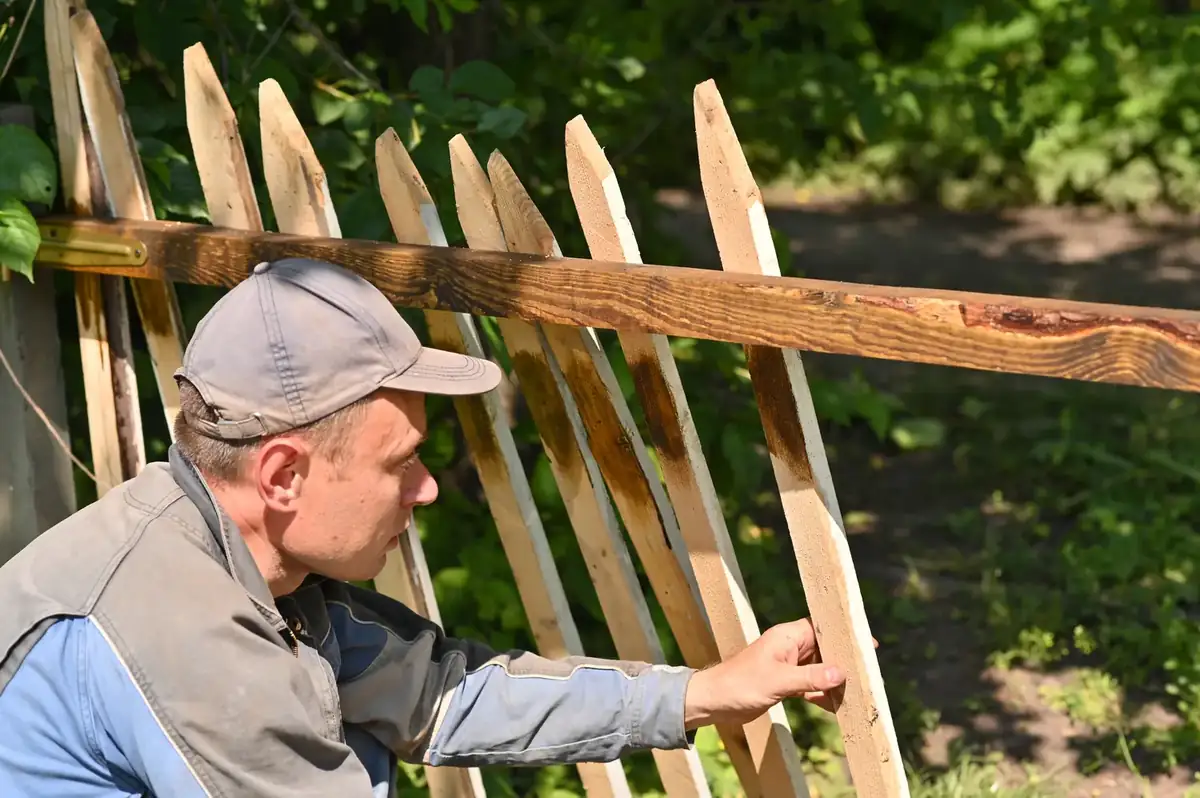
What we repair on a broken fence
Solid Rock Fencing repairs leaning and rotted posts, broken rails and boards, storm damage, impact damage, fire damaged sections, dragging gates, slack woven wire and animal damage on wood, wire and gated fence in Ohio and Pennsylvania. Most fence problems start at one weak spot, and a repair that finds that spot costs far less than letting the failure spread down the line.
- Leaning and rotted posts. Wood decays fastest at the ground line, where soil moisture meets air. A post that looks sound above grade can be soft an inch below it, and when it tips the rails pull the next post along.
- Broken rails and boards. A cracked rail, a split board or a popped fastener. These are the easy repairs, but a rail that keeps breaking in the same place usually points to a post that moved or a span that is too long.
- Storm and wind damage. Fallen limbs, a tree across the line, boards ripped loose, a section pushed over. We check the posts and soil first, because a post that tipped often had a weak footing before the wind arrived.
- Vehicle and equipment impact. A truck backing into a corner, a mower clipping a post, a tractor catching a gate. Impact can crack a post below grade, so we check the whole post and its neighbors.
- Burnt or fire damaged fence. Brush fires, burn piles that got away, a barn fire that reached the fence line. Charred wood has lost its strength, so the question is how much sound wood is left at the ground line and at the joints.
- Sagging and dragging gates. A gate that scrapes the ground, will not latch, or needs a lift to close. The gate is rarely the real problem. The hinge post has usually moved.
- Slack woven wire. Wire that bellies between posts, hangs loose off a staple line or has been stretched past what it can recover. Our page on field and woven wire fence covers how that wire is built and tensioned.
- Animal damage. Horses leaning on a top rail, cattle rubbing a corner post, a dog digging under a line, deer going through a weak panel. Animals find the weakest point and keep working at it.
Damage not on this list? Call (440) 241-4312 or send details through the FREE estimate request. A damaged wood privacy fence often turns out to be a post problem more than a board problem.
Why it matters that the same company builds and repairs
Many fence companies only build new fence. Solid Rock Fencing builds fence and also repairs it, and that changes how the repair gets done. A crew that only installs looks at a broken fence and sees a sale. A crew that builds and repairs looks at it and asks why it broke.
That question is the whole job. A builder knows what a sound footing looks like when the post comes out of the ground, and can tell whether the old fence skipped the corner brace, used a rail too thin for the span, or set a gate post that was never going to carry the gate. Sometimes the right answer is one post and two boards. Sometimes it is a rebuild of a run, and we will say so. The estimate is FREE either way.
Repair or replace, how to tell
Repair a fence when the damage is local and the posts around it are sound. Replace a section when the posts have decayed at the ground line, the brace assemblies are failing, or the same spot keeps coming back. The table below shows the usual dividing lines. These come from extension and forestry research plus shop judgment, and every fence still needs to be looked at in person.
| What you see | Usually a repair | Usually a replacement |
|---|---|---|
| Post | Sound post knocked slightly out of plumb, firm when pushed | Post soft, hollow or snapped at the ground line |
| Rails and boards | A few split or loose pieces on sound posts | Rails warped along the whole run, or thin rails that sag under load |
| Corner or end | Brace wire slack or a brace rail loose | Corner post leaning with the brace assembly failing |
| Gate | Hinge or latch adjustment, sound gate post | Gate post moved or rotted, frame racked out of square |
| Woven wire | Loose staples, a break that can be spliced | Wire rusted through or stretched past recovery |
| Fire damage | Surface scorch, sound wood at grade and joints | Charring at the ground line or at connections |
| Pattern | One bad spot with a clear cause | Failures spread along the run or return year after year |
A few of these deserve explanation. Decay concentrates at the ground line because that is where soil moisture meets air, and long-term post tests from the USDA Forest Service and Ohio State both found that failed posts failed from decay at or near grade. When a post is soft at grade, no amount of bracing fixes it.
Wire follows the same logic. Virginia Tech extension advises replacing smooth wire once it is rusty or stretched, and Langston University advises tightening woven wire only until the crimps flatten to about two thirds of their original height.
Fire damage is hard to judge by eye. Engineers who study burned heavy timber treat the charred layer as having no remaining strength. We apply the same thinking to a fence post and check what sound wood is left at grade and at the joints. A post standing is not proof it is sound.
What gets fixed in a visit and what turns into a rebuild
Small, local repairs can often be handled in a single visit, while anything that involves digging, bracing or several posts is planned as a larger job. We do not quote hours over the phone, because the honest answer depends on what we find when the damaged post comes out of the ground.
Repairs that are usually straightforward
- Replacing a few boards or a broken rail on sound posts.
- Re-hanging a gate when the gate post is still solid.
- Splicing a broken wire and refastening loose staples.
- Replacing one post where the neighbors are firm and the cause is clear.
- Re-tensioning slack woven wire once the end and corner assemblies are confirmed sound.
Repairs that grow into larger jobs
- A corner or end post that has moved. Corners and ends carry the pull of the whole wire run, so the brace assembly has to be rebuilt as well as the post.
- A run of posts decayed at the ground line. If one has gone, its neighbors share its age and soil.
- A gate that drags because the hinge post has tipped and the gate is too heavy for it.
- Fire damage that has run along a line, where wire, posts and rails are all in question.
- A section the old builder made too light for its job.
When a repair grows, we tell you before the work changes, not after, and we still price the smaller repair so you can compare.
What causes repeat failures and how to fix the cause
Fences fail again when a repair fixes the break and leaves the cause alone. Decay at grade, frost heave, weak bracing, loose wire and animal pressure explain most repeat repairs, and each has a different fix.
Rot at the soil line
Decay fungi need moisture, oxygen and wood to feed on. The soil supplies the moisture, so decay concentrates right at grade. Cuts and drilled holes in a treated post expose untreated wood inside, so field cuts need dressing, and a trade article from a Forest Service researcher names copper naphthenate for that. A replacement post should be rated for ground contact, or be a naturally durable species, and its setting should drain.
Frost heave
Frost heave needs three things, a freezing plane, fine-grained soil that lets moisture move, and a water supply. National Research Council Canada notes that fine sands and silts are very susceptible, and that vertical heave of 4 to 8 inches is common in susceptible soils. University of Wisconsin Extension warns that freeze and thaw in silt and clay can push dug posts out of the ground. A post that is only re-tamped will often heave again if the footing is shallow or the backfill holds water, so depth, backfill and drainage get fixed with the post. Frost depth varies by jurisdiction, so the local building office sets the number for your property.
Weak corners and brace assemblies
University of Georgia Extension reports that the pull on a wire fence corner or end can be around 3,000 pounds when wire is first stretched and can rise to about 4,500 pounds in winter cold. Mississippi State Extension adds that if a corner post moves half an inch, mild-steel barbed wire can lose over 20 percent of its tension. The brace assembly has to be rebuilt, and every line leading to the corner needs its own bracing.
Slack wire and loose fasteners
Wire stretches, staples work loose, and posts shift a little each year. University of Georgia advises re-tensioning high-tensile wire at least once or twice a year. Woven wire is repaired the same way every time. Fix the brace first, then release the tension at the affected end, refasten the wire, and re-tension to where the crimps flatten to about two thirds of their original height. That order is shop practice drawn from the loads above.
Animal pressure
Livestock test a fence hardest when there is something better on the other side. Cattle lean and climb, sheep crawl under, horses chew and rub. Treated boards discourage chewing but, as University of Georgia notes, may not stop it. Where a horse is working at a top rail, an electric strand set on the pasture side of the post, offset from the rail, is the usual extension answer.
Gates that keep dropping
Gates drag when the bracing is inadequate. Frost can push a post out of the ground, and the weight of the gate tips it further. A diagonal wire or cable from the top of the gate post to the next post shares the load, and Penn State puts corner and gate posts about 25 percent larger than line posts. Our gates page covers matching posts and hardware to the gate.
How a repair goes from first call to finished fence
The process runs from a FREE estimate to the finished repair, and every step happens at your fence with the damage in front of you.
- Call or send the requestCall (440) 241-4312 or use the FREE estimate page. Tell us what broke, how long ago, and whether animals, gates or a property line are involved.
- We look at the fenceWe walk the damaged section and the sound fence on either side. We check posts at grade, brace assemblies, wire, rails and the gate if there is one, and we look for the cause.
- You get the optionsWe explain what is a repair and what is a replacement, and why. If both are reasonable, you see both. See how estimates work.
- 811 gets calledBefore any digging, utility lines are located through 811 by whoever is doing the digging. That is the law in both states and it is part of the schedule.
- The repair is madeFailed posts come out, the footing is corrected, braces are rebuilt where needed, and rails, boards, wire or gates are replaced or adjusted.
- Final walk and cleanupWe walk the line with you, check that gates swing and latch, and leave the site clean. Warranty terms come in writing with the estimate.
Call 811 before any digging
Digging a replacement post counts as excavation, and in both Ohio and Pennsylvania it requires calling 811 first. Ohio law covers homeowners and professionals alike. OHIO811 requires notice at least two working days before digging, not counting the day of notification, weekends or legal holidays. Pennsylvania requires at least three business days through PA One Call.
Hand digging is still digging. If a contractor does the work, the contractor submits the notice, and Pennsylvania suggests asking for the contractor's PA One Call serial number as proof. Our 811 guide covers who calls and what the flag colors mean. Some service lines on private property are the owner's responsibility, so a private locator may be needed.
Matching the existing fence
A repair should look like it belongs. Matching means the same post size and spacing, the same rail dimensions and a finish close to the old color. New boards beside weathered gray ones will look different for a while, and our fence painting and staining service can narrow that gap.
Sometimes an exact match is not possible, because a rail profile or wire pattern is no longer easy to buy. We explain the nearest match and what will look different before work starts.
Repairing a fence on a shared line
If the fence sits on a boundary you share with a neighbor, who pays and who decides depends on where you live, and in some places on a written agreement between the owners. Rules vary by state, township and sometimes by HOA, and this is general information, not legal advice.
In Ohio, the partition fence statutes in Chapter 971 mainly apply to rural and farm parcels in townships. Unless a written agreement says otherwise, owners with a shared partition fence generally split the cost of building and maintaining it, and adjoining owners can change that by a written agreement filed with the county recorder. Our fence laws guide for Ohio and Pennsylvania explains what we could confirm. Talk to your neighbor before work starts and keep any agreement in writing.
We do not decide who owns a boundary or settle a dispute. If the line is in question, a survey comes first.
Mistakes to avoid with a broken fence
- Pushing a corner back upright. If the brace assembly is what failed, the corner will lean again as soon as the wire is tensioned.
- Tightening wire before checking the brace. If the corner moves, the line goes slack again.
- Screwing a board alongside a rotten post. It hides the problem for a season and leaves the decay in the ground.
- Setting a post in a bowl of trapped water. Footing and drainage decide how long the post lasts.
- Hanging a heavy gate on a light post. The post will keep moving.
Honest limits
We cannot say how long a repaired fence will last, because that depends on the wood, the soil, the weather and the animals. A replaced post lasts about as long as its material and its setting allow. Published sources give wide ranges for treated posts, such as 10 to 25 years from Penn State Extension and 20 to 35 years from Kentucky Extension, and a post that heaves or leans will not reach either figure.
We cannot always match old materials exactly, and we cannot make a worn fence behave like a new one. Heat can change wire in ways that are not visible, and no source we found gives a test for it, so we lean toward replacing wire that is discolored, brittle or kinked. And our 10 year workmanship warranty covers defects in workmanship only. It does not cover weather, impact, animals or normal wood aging. The full terms are on our warranty page and in the written estimate.
Get your FREE estimate
Tell us what you are fencing and where. We will talk it through with you and come out to walk the line.
Questions we hear
How do I know if my fence needs repair or replacement?
Repair fits local damage on sound posts, such as a few broken boards, a loose gate or slack wire. Replacement fits posts that are soft or snapped at the ground line, failing corner braces, or damage that keeps returning. A post that rocks in the ground or crumbles when probed near grade is usually past repair. A FREE estimate shows which side your fence falls on.
Do you repair fences that someone else built?
Yes. Solid Rock Fencing repairs fence we did not build as well as fence we did. Many fence companies only build new fence. We check the posts, braces and footings first so the repair does not fail at the same spot.
Can you fix a leaning corner post without rebuilding the whole fence?
Often yes, and the brace assembly is part of the fix. A corner on a wire fence carries thousands of pounds of pull, so we reset or replace the post and rebuild the bracing. If the posts beside it have decayed too, the repair may extend down the line, and we say so before the work starts.
Why does my gate keep dragging after I adjust it?
The hinge post has probably moved. Frost can push a post out, and the weight of the gate tips it further. Adjusting hinges only hides this. A durable fix re-sets or replaces the post, braces it, and then rehangs the gate. A gate that is too heavy for its post will keep settling.
Do you fix fire damaged fence?
We can look at it. Charred wood has lost its strength, so we check how much sound wood remains at the ground line and joints. Posts charred at grade usually get replaced. Wire that is discolored or brittle should be replaced too, because heat can change it in ways you cannot see.
Do I have to call 811 for a small post replacement?
Yes. Digging any post hole requires calling 811 in both Ohio and Pennsylvania, even by hand and even for one post. Ohio requires at least two working days of notice, and Pennsylvania at least three business days. The contractor doing the digging submits the notice for hired work.
Who pays to repair a fence I share with a neighbor?
It depends on your state, township and any written agreement. In Ohio, partition fence rules in Chapter 971 mainly cover rural parcels and generally split costs evenly unless owners agree otherwise in writing. Rules vary locally, and this is general information, not legal advice. See our fence laws guide and check with your township or county.
Does repair work come with a warranty?
Solid Rock Fencing offers a 10 year workmanship warranty, with full written terms provided in the estimate. It covers defects in our workmanship. It does not cover weather, vehicle impact, animals or normal wood aging, and it is not a promise about how long a fence will last.
- USDA Forest Products Laboratory, Protecting Wood Fences for Yard and Garden (1979)
- USDA Forest Service Rocky Mountain Research Paper RM-300
- Ohio Agricultural Experiment Station Research Circular 86
- Journal of Light Construction, Protecting fence posts from rot
- American Wood Protection Association, homeowner information
- UGA Circular 774, Fences for the Farm
- UGA Bulletin 1192, Fences for Horses
- Mississippi State Extension, livestock fencing systems
- Langston University goat fencing page
- Virginia Tech Extension, horse fencing (1999)
- National Research Council Canada CBD-26, frost heave
- University of Wisconsin Extension, setting fence posts
- Penn State Extension, Fence Planning for Horses
- Kentucky Extension FORFS 03-05, fence posts
- Grainews, tips to prevent and fix a sagging livestock gate (2016)
- STRUCTURE magazine, post-fire analysis of solid sawn heavy timber beams
- OHIO811 homeowner information
- OHIO811, when and how to notify
- Pennsylvania PUC, PA One Call
- Ohio Revised Code section 971.04
- Ohio Revised Code section 971.071