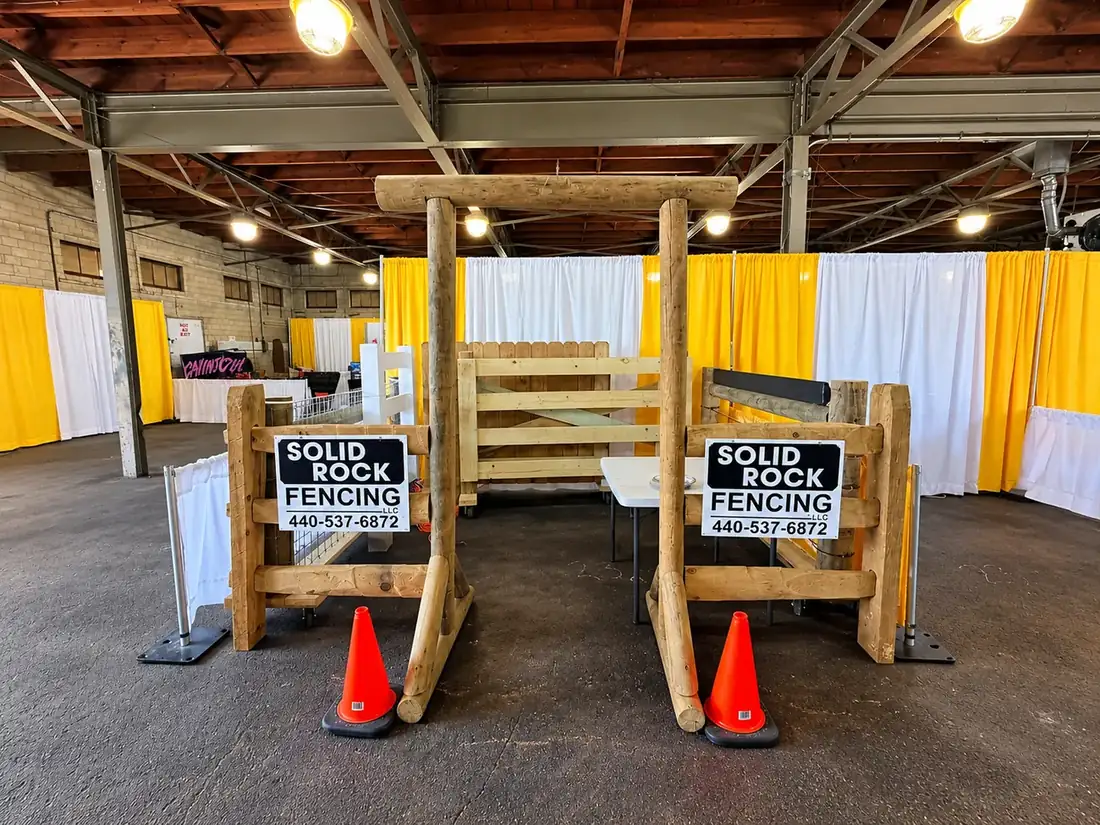
Solid Rock Fencing is a locally owned, family owned fence and gate contractor based in Bristolville, Ohio, serving Ohio and Pennsylvania. Estimates are FREE. This page lays out each stage so nothing about the process is a surprise, from the first call through the walk, the measuring, the written scope and what follows if you say yes. It is general information, and details such as scheduling depend on the job and the season. Call (440) 241-4312 with any question.
The process in six steps
Here is the sequence at a glance. There is no obligation at any point before you accept.
- CallYou describe what you want, where it goes and what it has to hold.
- Walk the lineWe go over the route with you and look at the ground, corners, gates and access.
- MeasureThe line is measured along its real route, with gates and corners counted.
- Write the scopeThe job is written down in detail so you can read it and compare it.
- ReviewYou take the scope home, ask questions and compare it with any other bid.
- Say yes, or notIf you go ahead, the utility locate and scheduling follow. If not, there is nothing owed.
The first call is a conversation
On the first call you tell us what you have in mind, and we ask questions to understand the job. You do not need exact measurements or a drawing. A rough description is enough. A horse owner says how many horses and how tall they are. A farm owner mentions cattle, sheep or goats, because the wire and the height depend on the animal. Someone replacing a privacy fence names the side of the lot. Penn State Extension suggests horse fence of 54 to 60 inches, while Ohio NRCS lists 42 inches as the minimum for sheep, so the animal changes the answer from the first minute.
If you are not sure what type of fence suits you, the call is a good time to talk it through. Our fence styles page gives an overview.
What to have ready
A few details make the visit shorter and the scope more accurate. None of them are required, and you can fill gaps on the walk.
- The address, and where on the property the fence will go.
- What the fence is for, and which animals or pets it must keep in or out.
- A rough length. Pacing the line or using a tape along the fence route is close enough.
- How many gates you want, how wide, and for whom: a person, a mower, a tractor, a truck.
- Whether there is an old fence to remove or repair.
- Any HOA, township or deed rules you already know about.
- Photos of problem spots, if you have them. They help us prepare, but they do not replace the walk.
- Whether you also want painting or staining, or repairs on a fence you already own.
What we look at on the walk
The walk is where a quote becomes real, because a photo or a phone description cannot show a soft spot, a slope, a root or a corner that must be braced. We go along the line with you and look at several things.
| What we check | Why it matters | What you can do |
|---|---|---|
| Ground and soil | Clay, sand, rock and wet ground change how posts are set | Tell us about past digging trouble |
| Corners and ends | Wire corners carry heavy pull and need bracing | Show us where the line should turn |
| Gates | Width, use and post size decide the hardware | Say who or what goes through |
| Access | Equipment must reach the line, or the work is by hand | Point out locked gates, trees, tight spots |
| Existing fence | Old fence may come out, be repaired or be reused | Tell us what is staying |
| Slope and drainage | Low spots and hills change post spacing and finish | Show us where water collects |
| Property line | The fence should follow the boundary you intend | Bring the deed, plat or survey if you have one |
Ground and posts
The soil decides more than most people expect. University of Wisconsin Extension notes that silt and clay can push dug posts out with freeze and thaw, and recommends sand and gravel backfill in those soils. Ohio NRCS calls for steel posts where soil is under 28 inches deep. Penn State describes a typical line post at about 36 inches deep and corner and gate posts at about 48 inches. We look at what the ground allows before we write a depth into the scope.
Corners, ends and gates
Wire pulls hard on its ends. UGA Circular 774 puts the pull at a corner at about 3,000 pounds when the wire is first stretched, and about 4,500 pounds in winter cold. That is why every corner, end and gate on a wire fence needs a brace assembly, and why we count them. On the walk we find each one and talk about where it should sit. For gates we ask the width, what will pass through and which way it should swing. Penn State suggests gates for people and horses be at least 4 feet wide, and gates for vehicles at least 12 feet.
Access and the existing fence
Equipment has to reach the line. If the route crosses a ditch, runs along a tree line or sits behind a tight gateway, the work changes. We also look at any fence already there. Sometimes it comes out. Sometimes parts are sound and a repair makes more sense than a rebuild. That call is made on the ground, post by post.
The property line
The fence is only as good as its location. Check your deed and plat, and look for corner pins or monuments. Ohio's boundary survey standards call for property corners to be marked with monuments where practicable. If your line is close to the boundary, a licensed surveyor can mark it before the posts go in.
Measuring the line
A good measurement follows the real route of the fence, not the straight line on a map. Length affects posts, rails or wire, labor and the number of corners. Slopes make the true length longer than the distance on the plan. We count the corners and the gates, because those drive the work more than raw footage.
Repair estimates
A repair estimate asks a different question: how much of the fence is still good? Many fence companies only build new fence. Solid Rock Fencing also does repairs, and we paint and stain. On a repair visit we check posts at the ground line, where decay concentrates and where posts snap. We check corner and end assemblies, the hinge posts on gates and the wire for slack, rust and kinks. Rails are checked for warping, and fasteners for rust.
Some findings point toward a repair and some toward replacement. A post that has rotted or snapped at the ground line should be replaced. Rusty or stretched smooth wire needs replacing. Georgia Extension says anchor and brace assemblies should be repaired whenever they show signs of weakness. A leaning corner needs more than a push. If failures run across the whole line, a rebuild may be better value than repeated repairs. That is our judgment, based on the walk, and we explain it.
Painting and staining estimates
For finishing work, we look at the wood. New treated lumber is wet, and a preservative maker says about 60 days after installation is typical before it is ready to stain. We look at old finish, mildew, loose paint and end grain, where finishes fail first. The scope lists the prep, the product type and the coats. See fence painting and staining.
What the written estimate lists
The written scope names every part of the job so you can read it, question it and compare it with any other bid. A quote that skips one of these items is worth a question. Here is what to expect to see.
- The address and where the fence runs.
- Fence type, height and total length.
- Each gate, with width, type, swing and hardware.
- Post material, size, treatment level, spacing and depth.
- Rails, boards or wire, with gauge and class where they apply.
- Corner, end and gate bracing.
- Fasteners and finish, if any.
- Removal of old fence and cleanup, and what is excluded.
- Who handles the 811 locate and any permit paperwork.
- The 10 year workmanship warranty terms.
For how these items move a price, read what affects fence cost. We do not print prices on the site, because a fair number needs your ground.
The 10 year workmanship warranty
Solid Rock Fencing offers a 10 year workmanship warranty, and the full written terms come with your estimate. It covers defects in workmanship. It does not cover weather, impact, animals or normal wood aging. Read the terms before you decide, and ask about anything that is unclear. The warranty page describes it in more detail.
What happens after you say yes
Once you accept, the work is set up in order. The first step is the utility locate, and the rest is scheduling. Timing depends on the job, the season, the ground and the weather, so we do not promise dates on a web page.
- Confirm the scopeYou and we agree on the written scope and any changes.
- Utility locateThe excavator submits the 811 notice, and you can ask to see proof.
- Permits and rulesAny permit your township or municipality requires is sorted out first. Ask who files it.
- SchedulingA start is set once marks are in place, and weather and ground are considered.
- BuildPosts, bracing, rails or wire and gates go in as written.
811 before any digging
In Ohio, OHIO811 requires notice at least two working days before digging, not counting the day of notification, and a ticket is valid for 16 calendar days. In Pennsylvania, PA One Call requires notice not less than three business days and not more than ten business days before excavation. When a contractor digs, the contractor submits the notice. Both services advise you to confirm it was done, and in Pennsylvania you can ask for the 11-digit serial number as proof. See call 811 before you dig.
Questions to ask any fence contractor
These apply to us and to everyone else you talk to. Specific questions get specific answers, and fence work has details you cannot see after the job is done.
- Who calls 811, and can I see proof that it was done?
- What post material, size, treatment category and depth does this quote assume?
- How are the corners, ends and gates braced?
- What fasteners, wire class and finish are included?
- What is included, and what costs extra if the ground is harder than expected?
- Who removes the old fence, and who cleans up?
- What does the warranty cover, what does it leave out, and is it in writing?
- Is everything in this scope written down?
Mistakes to avoid when getting estimates
- Accepting a price over the phone without anyone seeing the line.
- Comparing totals without comparing scopes.
- Forgetting to mention the old fence, the gates or the leaning corner.
- Guessing at the boundary instead of checking pins, a deed or a survey.
- Assuming the contractor will handle permits and 811 without asking.
- Signing before you have read the warranty terms.
After the estimate
There is no obligation. Take the scope home, read it and compare it. Call back with questions. If you want to see examples first, our work page shows fence and gate jobs, and our services describes each fence type. When you are ready to start, call (440) 241-4312 or use the FREE estimate page.
Get your FREE estimate
Tell us what you are fencing and where. We will talk it through with you and come out to walk the line.
Questions we hear
Is the Solid Rock Fencing estimate really FREE?
Yes. Solid Rock Fencing offers FREE estimates, with no charge for the visit and no obligation to hire us. Call (440) 241-4312 to ask for one, and ask any questions about the process before you book the walk of your fence line.
What should I have ready before I call?
The address, what the fence is for, a rough length, the number and use of gates, and any animals it must hold. Exact measurements are not needed. Tell us about any HOA or township rules, and mention an old fence that has to come out.
Do I need to be home for the walk of the fence line?
It helps a lot. You can point out problem spots, gates and corners and say what you want the fence to look like. If you cannot be there, say so on the call and ask how the visit can work.
Will the estimate be in writing?
Yes. After the walk, the job is written down as a scope listing the fence type, height, length, gates, posts, bracing, materials and what is included or left out. The 10 year workmanship warranty terms come with the estimate, so you can read both together before deciding anything.
Can you estimate a repair instead of a new fence?
Yes. Many fence companies only build new fence, but we also repair and we paint and stain. On the walk we check posts at the ground line, corner assemblies, gate posts, wire and rails to see what is worth saving and what should be replaced.
Who calls 811 before digging?
The person digging. When a contractor does the work, the contractor submits the notice, and you should confirm it was done. Ohio needs notice at least two working days before digging, and Pennsylvania at least three business days. Marks affect post placement.
Do I need a permit for my fence?
It depends on your location. Ohio has no statewide fence permit we found, and Pennsylvania exempts residential fences up to 6 feet from the Uniform Construction Code, but townships, municipalities and HOAs set their own rules. Check with your local office. This is general information, not legal advice.
- Penn State Extension, Fence Planning for Horses
- Ohio NRCS woven wire fence specification (August 2016)
- University of Wisconsin Extension, Setting Fence Posts
- UGA Extension Circular 774, Fences for the Farm
- Viance, Staining Decks and Fences
- Ohio Administrative Code Chapter 4733-37, boundary surveys
- OHIO811, when and how to notify
- OHIO811, when a ticket expires
- PA One Call, excavators
- PA One Call, homeowner FAQs
- Pennsylvania Uniform Construction Code, quick guide to residential provisions
- Trumbull County Planning Commission, plats and zoning
- Mahoning County, residential permitting process
- Ohio Revised Code section 971.03, scope of partition fence law
- Ohio Revised Code section 971.04, written partition fence agreements
- Pennsylvania Farm Bureau, boundary and fencing laws