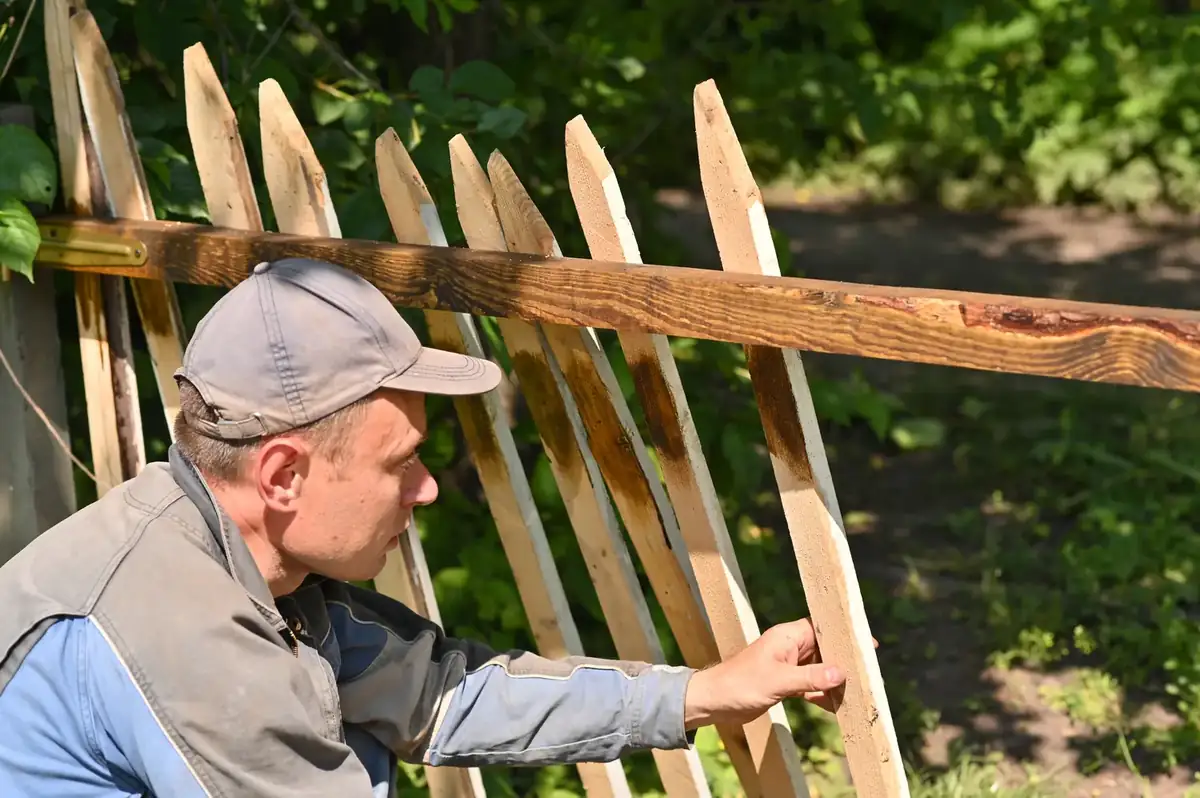
Paint, stain or sealer, which one fits your fence
Paint forms a film on top of the wood, stain soaks into it, and a water-repellent sealer mostly slows moisture without adding much color. Solid Rock Fencing paints and stains fences, so we can talk through the choice with the fence in front of us. Which one fits depends on the wood, how rough or smooth it is, and how much upkeep you want to sign up for.
| Finish | How it works | Best on | Watch for |
|---|---|---|---|
| Paint | Builds a film that sits on the surface | Smooth, well-primed wood | Can blister, crack and peel when moisture gets under it |
| Solid-color stain | A thicker pigmented stain that hides more grain | Weathered or mixed-color boards | Old solid finish must come off before a penetrating stain |
| Semitransparent stain | Soaks in, adds color, shows grain | Rough-sawn and flat-grain lumber | Fades with sun and needs recoating when it does |
| Water-repellent sealer | Slows water, adds little color | New wood you want left natural | Short service life in published tests |
The published numbers are worth knowing. The USDA Forest Products Laboratory finishing handbook lists expected life in years for similar exterior wood such as cedar and redwood. Water-repellent preservative is 1 to 2 years on smooth wood and 2 to 3 on rough. Semitransparent stain is 2 to 4 years on smooth cedar and 5 to 8 on rough-sawn cedar. Paint is 4 to 6 years on smooth cedar and 3 to 5 on rough. A fence is not a listed row in that table, so treat the figures as a comparison between finishes, not a forecast for your fence.
Purdue Extension gives a similar picture. A single coat on new wood lasts 2 to 4 years, and a two-coat wet system on rough wood may last up to 10. It names film-forming acrylic latex paint and solid-color acrylic latex stain as the most protective, and notes that semitransparent stains let the surface deteriorate faster. So the sources do not agree on one winner. The fair summary is that paint protects longest on smooth, primed wood, while penetrating stain is easier to live with on rough lumber because it fades instead of peeling.
We do not promise how long any finish will last on your fence. Sun, shade, moisture and the age of the wood all change the result.
When new treated wood can be painted or stained
Fresh treated lumber is wet, and finish applied over wet wood fails early. The wood is ready when water soaks in instead of beading, which can mean weeks to a couple of months. Viance, a wood preservative maker, says treated wood will typically dry and be ready for finishing about 60 days after installation, depending on the time since treatment, sun, temperature and weather.
That is a manufacturer's figure, so use it as a guide and not a rule. The water test is the practical check. Sprinkle a few drops on the board. If they soak in readily, the wood is dry enough for stain, paint or sealant. If they bead, wait. Kentucky Extension likewise advises letting posts air-dry a few months before painting, because paint on wet wood traps moisture. The USDA finishing handbook adds that paint blisters and peels when wood is above 20 percent moisture content when it is painted.
Wood left bare for a long time has the opposite problem. The same handbook says even a few days of exposure will reduce the paintability of new, clean wood, and it notes that penetrating finishes suit somewhat weathered wood because it absorbs more of them. So there is a window, after the wood has dried and before it has weathered hard. If you are planning new fence and want a particular finish, mention it in the FREE estimate and we will plan the timing with you.
Preparation decides how long a finish holds
Finishes fail when they go over dirt, mildew, loose old coating or damp wood, and no product fixes that afterward. The usual order is repair, clean, dry, then finish.
- Repair firstReplace rotted rails, reset loose boards and fix leaning posts before anything gets finished. Painting over a failing post only hides it. This order is shop practice, and it is why having repair and finishing in one company helps. See fence repair.
- Remove loose finishScrape what is flaking and feather the edges with sandpaper. Strip old finish before repainting if it is badly peeled or blistered or if heavy buildup is cracking across the grain. Old paint or solid-color stain has to come off before a penetrating stain goes on.
- Clean the surfaceScrub with a stiff brush. A wood cleaner handles dirt and mildew, and a brightener helps on severely weathered wood. Purdue Extension gives one cup of household bleach to three cups of water for mildew, and warns never to mix bleach with ammonia.
- Let it dryCabot, a stain maker, says to let cleaned wood dry 24 to 48 hours and not to apply over wet surfaces or when rain is expected.
- Finish promptlySanded or cleaned wood weathers fast. The Forest Products Laboratory notes that even a week of sunlight can weather unfinished wood and shorten paint life, so we do not leave bare wood waiting.
Weather and temperature windows
There is no single right month in Ohio or Pennsylvania, and the product label is the rule to follow. Every stain and paint lists a temperature range, a drying time and a rain warning, and those limits come from the maker's testing. We follow them, which sometimes means a job waits for a better day.
Here is what the sources do say. Purdue Extension advises against applying finishes to very hot or very cold surfaces, and against painting a cold surface the sun will soon heat, because temperature blisters are likely. The one oil stain maker we checked, Cabot, says not to apply in direct sunlight, to hot surfaces, or when air or surface temperature is below 50 degrees Fahrenheit, nor if the temperature may fall below that within 48 hours. It lists about 24 hours of drying depending on temperature and humidity. Another product will have other limits. We did not find a sourced calendar of best months for either state, so we do not invent one.
How many coats and when to recoat
One coat is common on smooth, new wood, and two coats go on rough or weathered wood, but the label controls. The USDA finishing handbook says smooth unweathered surfaces generally take one coat of stain, while rough or weathered surfaces can take two, with the second applied while the first is still wet. For paint, its figures assume primer plus one topcoat, and it says a second topcoat will approximately double the life. Some oil stains, such as the Cabot product we checked, are labeled for one coat only.
Recoat intervals are where the published numbers are widest. The ranges in the table above are the sourced ones, and they are ranges because wood and exposure vary. A better signal than the calendar is a splash test, described by Purdue Extension. Sprinkle water on the fence. If it beads, the finish is still working. If it soaks in, the wood is losing protection. Cabot suggests checking the fence each spring. Recoating before a finish fails is easier than stripping it after.
Why black four-board fence is so popular, and what to expect
A black four-board fence is one of the most recognizable looks on a horse or cattle farm, and many of the pastures in our job photos have it. It reads clean against green grass, frames a barn, and hides the dirt, dust and mud splash that show quickly on pale wood. Those are appearance points, not research findings. We found no extension source on black fence color.
Here is what we can say honestly. Visibility is a real consideration for horse fence. Penn State Extension notes that horses are far-sighted and that fence should be visible even up close, and University of Georgia says rail fences look solid to horses. A visible rail fence helps, whatever its color. We did not find a sourced answer on how a dark finish behaves in summer heat, so we do not make claims about it.
- Fading. A black semitransparent stain will lighten with sun and weather. A rough-sawn board holds stain better and fades more evenly than a smooth one.
- Touch-ups show. A dark finish makes patchy repairs obvious. Re-doing a full run looks better than spot work.
- Rough or smooth boards. Rough-sawn lumber takes penetrating stain well. Smooth planed boards lean toward paint or a solid-color stain.
- The post tops and cut ends. These weather first and need the most attention.
- Do not use asphalt or coal-tar coatings. University of Georgia lists them as a protective option, but they raise safety and regulation questions near animals, and we do not recommend them.
Planning black on a new fence means waiting for treated lumber to dry first. Our horse fence and farm and ranch fence pages cover how the fence itself is built.
Rails and end grain need extra care
End grain and the top faces of horizontal rails are the first places a finish fails. The USDA finishing handbook says the end grain of wood absorbs moisture faster than face grain, and finishes generally fail there first. Purdue Extension says a water repellent reduces moisture absorption through end grain and surface checks, and advises sealing ends and edges before installation.
Horizontal rails also hold standing water and take the most direct sun. That is our reasoning, not a quote, though it fits the lower life figures the Forest Products Laboratory gives for decking than for vertical siding. In practice this means we pay attention to rail tops, cut ends at posts and the joints where water collects. When we build new fence and know it will be finished, sealing cut ends before the rails go up is the better order of work. The same attention applies to the repaired section when we repair a fence and match the color.
The finishing handbook also notes that excessive dimensional change in wood constantly stresses a film-forming finish such as paint. A penetrating stain does not form a film, so it is often the lower-maintenance choice on rough rails.
Horses, livestock and fence finishes
Ask the product maker whether a finish is safe for animal contact, wait for the full cure time before turnout, and keep animals from chewing the wood. We did not find a veterinary or extension source covering modern exterior latex paint or stain swallowed by horses, so we do not claim any product is horse-safe. Your veterinarian and the product label are the right authorities.
A few points are sourced and worth knowing.
- Chewing is not stopped by treatment. University of Georgia says treated wood discourages chewing but may not be enough to stop it, and stressed or confined horses may still chew. An electric strand on the pasture side of the post, offset from the rail, can keep horses from rubbing or chewing a board.
- Old paint can contain lead. HorseDVM, a veterinary information site, reports that lead was used in most paint before 1977 and that horses are exposed by chewing painted wood. It advises against letting horses reach lead-painted structures.
- Some preservatives do not belong near mouths. The eXtension horse resource advises against creosote or pentachlorophenol-treated wood in places where horses could bite or lick it, and says treated wood should not contact feed or water.
- Keep wet finish away from animals. Hold stock off freshly finished rails until the label's cure time has passed.
If you keep livestock, tell us at the FREE estimate what animals are on the fence and where they go. We will plan the work around them.
Spraying, rolling and brushing
Brushing pushes penetrating stain into the grain best, while spraying covers long runs faster, so the right method depends on the finish and the fence. Purdue Extension says brushing should give better penetration and performance on textured surfaces. Cabot lists brushes, stain pads or professional spray equipment as acceptable, and says to back-brush right after spraying and to work one to three boards at a time, edge to end, to avoid lap marks.
Spraying saves time on a long rail run, but overspray can drift onto grass, stock or a neighbor's vehicle. We choose a method per fence and per product, and we protect what should not get coated.
What we promise and what we do not
Solid Rock Fencing paints and stains fences, whether we built them or someone else did. We promise careful prep, following the product label and telling you the truth about the condition of your wood. We do not promise a lifespan for any finish, or a color result that cannot be guaranteed on weathered wood.
- We will say when wood is too wet, too rotted or too weathered to finish well.
- We will recommend repair before finishing when posts or rails are failing.
- We will not guarantee how many years a finish lasts, because sources show wide ranges and weather decides the rest.
- We will not promise a match to your old color on aged boards, since weathered and new wood take color differently.
- Our 10 year workmanship warranty covers defects in workmanship only, with terms in the estimate. See the warranty page. It does not cover weather or normal wood aging.
Choosing the wood and the finish together makes both do better. Our premium fence materials guide explains what to look for in posts and rails before any finish goes on.
Get your FREE estimate
Tell us what you are fencing and where. We will talk it through with you and come out to walk the line.
Questions we hear
Can you stain a brand new pressure-treated fence right away?
Not usually. Fresh treated lumber is wet, and a finish over wet wood tends to fail. Viance, a preservative maker, says about 60 days is typical, and a water test tells you for sure. If drops soak in, the wood is ready. If they bead, wait. We check boards in the shade as well as the sun.
Is paint or stain better for a wood fence?
It depends on the wood. Paint protects longest on smooth, primed boards. Penetrating stain is easier to maintain on rough-sawn lumber because it fades rather than peels. Published sources disagree on a single winner, so we look at your boards before recommending either one.
How often does a fence need to be stained or painted again?
There is no fixed schedule. Published ranges run from 1 to 2 years for water-repellent sealers up to about 10 for a two-coat system on rough wood, and your fence could land anywhere in that span. Use the splash test. If water beads, the finish still works. We do not promise a lifespan.
What temperature is too cold to stain a fence?
Follow the product label. The oil stain maker we checked says not to apply below 50 degrees Fahrenheit, and not if the temperature may drop below that within 48 hours. Other products differ. We do not give a calendar of best months, and we will wait for a better day if conditions are wrong.
Is it safe to paint or stain a fence around horses and cattle?
Check the label and ask the manufacturer about animal contact, wait for the full cure time before turnout, and prevent chewing. We found no veterinary source confirming any modern finish as horse-safe, so we do not claim one. Your veterinarian is the right person to ask. Old pre-1977 paint can contain lead.
Do you paint and stain fences you did not build?
Yes. Solid Rock Fencing paints and stains fences, including ones other builders put up. We look at the condition first. If posts or rails are failing, we recommend repair before finish, because paint on a failing fence is money spent on the wrong end of the problem.
Why does paint peel first on rails and post tops?
End grain absorbs moisture faster than face grain, and finishes fail there first, according to the USDA finishing handbook. Horizontal rail tops also hold standing water and take the most sun. Sealing cut ends before assembly and giving those areas extra attention helps a finish last longer.
Will a black stain look the same on an old fence as on a new one?
Not exactly. Weathered boards absorb stain differently than new ones, so the same black can look uneven at first. Rough-sawn wood tends to take penetrating stain well. We will tell you what to expect for your boards before we start, and we do not promise a perfect match.
- USDA Forest Products Laboratory, Finishing of Wood (AH-647)
- USDA Forest Products Laboratory, Protecting Wood Fences for Yard and Garden (1979)
- USDA Forest Products Laboratory, Stripping Paint From Exterior Wood Surfaces
- Purdue Extension NCR-132, exterior finishing
- Viance, staining decks and fences
- Cabot Australian Timber Oil product literature
- Kentucky Extension FORFS 03-05, fence posts
- UGA Bulletin 1192, Fences for Horses
- Penn State Extension, Fence Planning for Horses
- HorseDVM, lead poisoning in horses
- eXtension horses, treated wood and horses