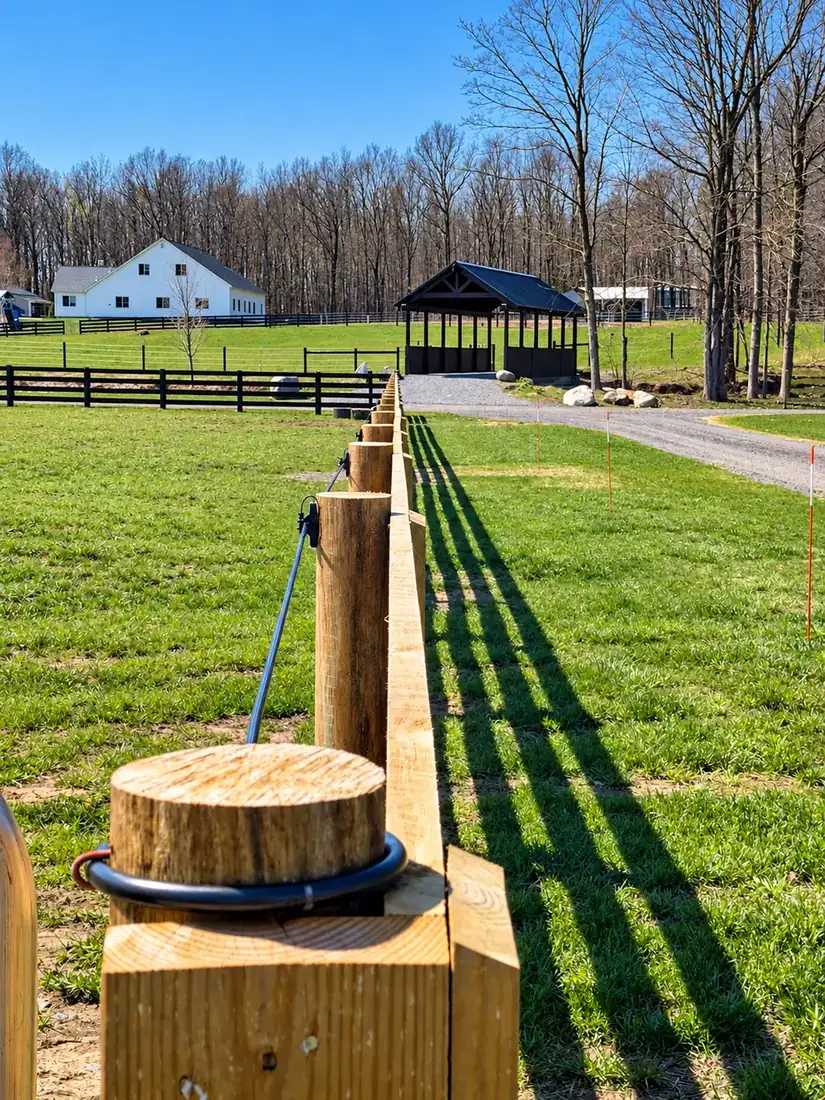
Anyone who quotes you a flat price per foot without seeing the ground is guessing. Two fences of the same length can land far apart because of what is under the grass, how many corners the line turns and how many gates hang on it. This page walks through the factors that move a quote so you can read a bid, compare two of them fairly and know what to ask. It prints no prices on purpose, because a number that fits a flat lot would be wrong on a rocky hillside.
Solid Rock Fencing is a locally owned, family owned fence and gate contractor based in Bristolville, Ohio, serving Ohio and Pennsylvania. Estimates are FREE, and every quote is written after we walk your line. Call (440) 241-4312 to start one.
Every quote starts with a walk of the line
A real number needs a person standing on your property, because the biggest cost drivers cannot be seen from a photo. A soft spot, a buried rock shelf, a slope, a tree root, a corner that has to take wire pull and a gate that must carry a tractor all change the work. After the walk, the job is written down as a scope with the fence type, height, length, gates, posts, and what is and is not included. How a FREE estimate works shows the steps from the call to the written scope.
The factors at a glance
Most of what moves a fence quote falls into a short list of factors, and you can think about each one before the estimate. The table names the factor, why it matters and what to have ready.
| Factor | Why it moves the quote | What to tell us |
|---|---|---|
| Length of line | More posts, rails or wire, and more labor | Rough length, or the sides of the lot |
| Fence type and height | Taller fence means longer posts, deeper holes, more material | What it must hold, in or out |
| Terrain | Slopes and wet spots slow the work | Hills, ditches, low spots |
| Soil and rock | Clay, sand and rock need different methods | Past trouble digging, shallow bedrock |
| Corners and curves | Each corner needs bracing, curves need closer posts | Where the line turns |
| Gates | Heavier posts, bracing and hardware | How many, how wide, for whom |
| Post size and grade | Diameter, treatment level and species vary | Any preference for post type |
| Old fence removal | Tear-out and hauling are extra work | What is there now |
| Access | Equipment that cannot reach the line means hand work | Tight yards, locked gates, trees |
| Permits and rules | Height limits and setbacks can change scope | HOA, township or deed rules |
Length, shape and straight runs
A long straight run is the cheapest fence to build per foot. University of Missouri Extension says a straight continuous stretch costs least, and that every added corner, anchor, gate or stream crossing adds time and expense. A plain rectangle costs less per foot than a line that zigzags around a pond and a barn.
Curves have their own rule. The Massachusetts NRCS fence standard tightens post spacing as the line bends, from 14 feet at small offsets down to 6 feet at an offset of 16 inches or more. So a fence that follows a creek bank takes more posts per hundred feet than one along a road.
Fence type and height
The type of fence is usually the largest single factor, and height multiplies it. A single electric wire inside a pasture, a woven wire fence with a top strand and a four-board horse fence are very different jobs. Taller fence means longer posts, deeper holes, more rail or wire and often heavier gates. The animal sets the height. Ohio NRCS gives minimums of 48 inches for cattle, goats and horses, 42 inches for sheep and 36 inches for swine, while Penn State suggests 54 to 60 inches for horses.
Our pages on farm and ranch fence, horse fence and wood privacy fence describe how each one is built.
Posts, depth and soil
Posts are the part you cannot see once the fence is finished, and the part that does the most work. Diameter, length, treatment and depth all change the cost. Penn State describes a typical line post at about 36 inches deep, with corner and gate posts about 25 percent larger and set about 48 inches deep. Ohio NRCS calls for steel posts where soil is under 28 inches deep, which is one way shallow bedrock changes a job.
Soil changes how fast the work goes and which method fits. Clay, sand, rock and wet ground each ask for something different. University of Wisconsin Extension says to backfill with sand and gravel in silt and clay, because freeze and thaw pushes dug posts out. The frost depth that applies is set locally. The documents we checked show figures from 30 to 42 inches in the places they cover, and your township or building office sets yours.
Post grade is a cost lever
Not every treated post is the same. The American Wood Protection Association rates ground-contact wood as UC4A for ordinary exposure and UC4B for high-decay sites and hard-to-replace parts. A higher category or a naturally durable species can cost more, and the end tag on the post tells you what you are getting. A cheaper post is not a bargain if it is thin lumber treated for above-ground use only, because that rots early in the soil. See the fence materials guide and premium fence materials for how to read a tag.
Corners, braces and gates
Corners and gates cost more than the plain line, because they carry the load. On wire fence, UGA Circular 774 puts the pull on a corner or end at about 3,000 pounds when wire is first stretched, rising to about 4,500 pounds in winter cold. Ohio NRCS requires braces at all corners, gates, pulls and ends. Each line leading to a corner needs its own brace assembly. A quote that treats a corner like any other post is leaving something out.
A gate costs more than the same length of fence. A 4 foot walk gate is small hardware. A 16 foot tractor gate is a structure, and Penn State says gates should be as tall as the fence and hung on posts about 25 percent larger than the line posts. Georgia Extension wants gate posts at least 8 inches across at the top. Ask how many gates the quote includes, and the width and type of each. Gates explains the choices.
Terrain and access
Hard ground and hard access slow every step. Missouri's farm fence guide assumes gently rolling land and adds 5 percent of material cost for difficult ground. That is a Missouri budgeting assumption, not our figure. Access matters too. A line behind a locked gate, along a tree line that needs clearing or across a ditch takes more time.
Material grade beyond the posts
Rails, wire and fasteners also come in grades that change the price. Georgia Extension says 1 by 6 rails cost less but warp more and are weaker than 2 by 6. Wire comes in gauges and galvanizing classes, from Class 1 with the lightest zinc to Class 3 with roughly two to three times as much. Fasteners range from plain steel to hot-dip galvanized to stainless, and treated wood is hard on plain steel. These differences are the reason a quote that looks low may be buying lighter parts. The owner states that the materials Solid Rock Fencing uses are high quality and premium, so ask for the grades in writing and compare them line by line.
Removing an old fence
Tearing out and hauling away an old fence is real work and belongs on its own line. Pulling old posts, cutting wire, loading, disposal and filling holes take time, and posts set in concrete take longer. Ask whether removal is included, who hauls it, and what the cleanup covers.
Repair versus replace
A repair can cost far less than a rebuild, if the fence is sound enough to save. Fence repair is part of what we do, and many fence companies only build new fence. The question is how much of the fence is still good. A post that has rotted or snapped at the ground line should be replaced. A leaning corner usually means the brace assembly needs repair, not just a push. Georgia Extension says anchor and brace assemblies should be repaired whenever they show signs of weakness. If posts are failing across the run, or the same corner keeps needing work, a rebuild is often the better value. That is a judgment, and the walk of the line is how we make it.
Painting and staining as an added cost
Painting or staining adds its own labor, and what it costs depends on the prep, not just the paint. We paint and stain fences, including fences we did not build. The cost drivers are the surface area, how rough the wood is, the number of coats and the condition of the old finish.
- Prep. Wood is scrubbed with a stiff brush and a wood cleaner, mildew is treated, loose paint is scraped, and severely peeled finish is stripped. Then the wood has to dry for 24 to 48 hours, per one stain maker.
- Waiting. New treated lumber is wet, and a preservative maker says about 60 days after installation is typical before staining. A water drop that soaks in is the test.
- Coats. The Forest Products Laboratory says a second topcoat of paint approximately doubles its life, and rough or weathered wood can take two coats of stain.
- Method. Purdue says brushing penetrates better on textured wood. Spraying is faster on long rails but is followed by back-brushing.
- Weather. One stain maker will not apply below 50 degrees Fahrenheit or if the temperature may drop below that within 48 hours, so the schedule depends on the forecast.
See fence painting and staining for the full process.
Permits and local rules
Local rules can change the scope, and they vary by township, municipality and HOA. Under the Residential Code of Ohio, as summarized in an Ohio permit guide, a building permit is not required for a fence 6 feet or less, and over 6 feet it is. Pennsylvania's Uniform Construction Code exempts residential fences up to 6 feet, though a municipality can still require its own zoning permit. Height limits, setbacks and materials are set locally, and front-yard fences are often limited to a lower height. See fence permits and rules, then ask your township or HOA before you choose a height.
Calling 811 and surveys
Utility locating and boundary checks add steps, and they protect you. Ohio law requires notice to OHIO811 at least two working days before digging, and Pennsylvania requires PA One Call at least three business days before. When a contractor digs, the contractor notifies, and you should confirm it was done. See call 811 before you dig. If your line sits close to the boundary, a licensed surveyor can mark it before the posts go in.
How to compare quotes
Quotes only compare if they describe the same fence, so line them up before you look at the bottom. Use this checklist for each bid.
- Same fence type, height and length on both.
- Same number and size of gates, and what each gate is made of.
- Post material, diameter, length and depth, and how they are set.
- The use category on treated posts and the grade of rails, wire and fasteners.
- How corners, ends and gate posts are braced.
- Whether old fence removal, hauling and cleanup are included.
- Who calls 811 and whether you can see proof.
- What happens if rock or wet ground is hit, and how extra work is priced.
- Finishing, if any: prep, coats and waiting time.
- Written warranty terms, and what they cover and leave out.
What a written scope should list
A written scope should let a stranger build the fence without calling you. If it is vague, ask for more detail before signing. At minimum it should list the following.
- The address and a description of where the fence runs.
- Fence type, height and total length.
- Each gate, with width, type and hardware.
- Post size, material, treatment level, spacing and depth.
- Rails, boards or wire, with gauge and class where they apply.
- Fasteners and finish.
- Corner and end bracing.
- Removal and cleanup, and what is excluded.
- Permit and utility locate responsibilities.
- The 10 year workmanship warranty terms, which come with the estimate. They cover defects in workmanship, not weather, impact, animals or normal wood aging. See our warranty.
Mistakes to avoid when pricing a fence
- Comparing bids by the total alone, when one bid has lighter posts or fewer braces.
- Asking for a price per foot over the phone and trusting it.
- Leaving gates out of the first conversation, then adding several later.
- Forgetting that old fence removal is a separate task.
- Choosing the cheapest option on a line that will hold horses or heavy livestock.
- Skipping the boundary check.
Get your FREE estimate
Tell us what you are fencing and where. We will talk it through with you and come out to walk the line.
Questions we hear
Why do you not list prices on this page?
Because a fair number needs the ground, the corners and the gates in front of someone. We found no dated national average for residential fence in a neutral source, and farm cost studies belong to other states. We give a written quote after a walk of your line, and the estimate is FREE.
What drives fence cost the most?
Fence type, height and length lead the list, then the ground, the number of corners and gates, and the grade of posts and wire. Access and old fence removal add labor. Painting and staining add prep and coats. The factor table on this page gives each one a short explanation.
Is repairing a fence cheaper than replacing it?
Often, when the posts and brace assemblies are sound. A rotted post or a loose corner can be replaced without rebuilding the run. When failures are spread across the line, replacing is usually better value. We make that call by walking the fence, not from a photo.
Does painting or staining cost extra?
Yes. Prep, drying time, coats and weather windows all add labor. New treated wood may need about 60 days to dry before staining, per one preservative maker. We paint and stain fences we built and fences we did not, and the scope lists the steps.
How do I compare two fence quotes?
Match the fence type, height, length and gates first. Then compare post material, depth, bracing, rail and wire grade, fasteners, removal and cleanup, and who handles 811. A quote that is lower on the bottom line may include lighter parts. Ask for both in writing.
Do gates change the price much?
Yes. A gate needs a heavier post, a brace and hardware, and a wide drive gate is a structure of its own. Tell us how many gates you want, how wide, and who or what will pass through. Gates are best settled at the walk.
Do permits affect what a fence costs?
They can. Height limits, setbacks and materials are set by your township, municipality or HOA, and a permit may be needed for a tall fence. Rules vary, so check with the local office. This is general information, not legal advice.
- University of Missouri Extension G1193, Missouri Farm Fence Costs (January 2024)
- Ohio NRCS woven wire fence specification (August 2016)
- Massachusetts NRCS fence standard 382 (2011)
- Penn State Extension, Fence Planning for Horses
- UGA Extension Circular 774, Fences for the Farm
- UGA Extension Bulletin 1192, Fences for Horses
- University of Wisconsin Extension, Setting Fence Posts
- American Wood Protection Association, homeowner information
- Viance, Staining Decks and Fences
- Cabot, Australian Timber Oil product data sheet
- USDA Forest Products Laboratory, Finishing of Wood (AH-647)
- Purdue Extension NCR-132, Exterior Wood Finishing
- Ohio fence permit guide (March 2026)
- Pennsylvania Uniform Construction Code, quick guide to residential provisions
- Trumbull County Planning Commission, plats and zoning
- Mercer County Regional Planning Commission, municipal zoning ordinances
- OHIO811, when and how to notify
- PA One Call, excavators
- Penn State Housing Research Center, Soil Freeze Depth Guide
- Red Brand, wire galvanization